
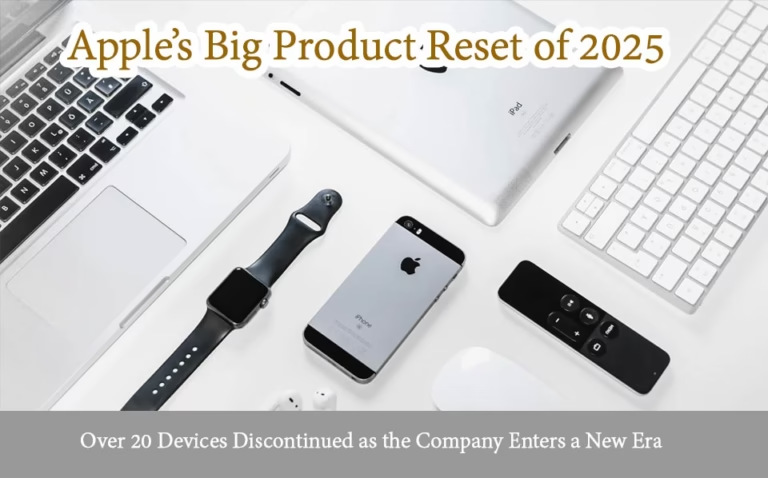



Apple’s Big Product Reset of 2025: Over 20 Devices Discontinued as the Company Enters a New Era
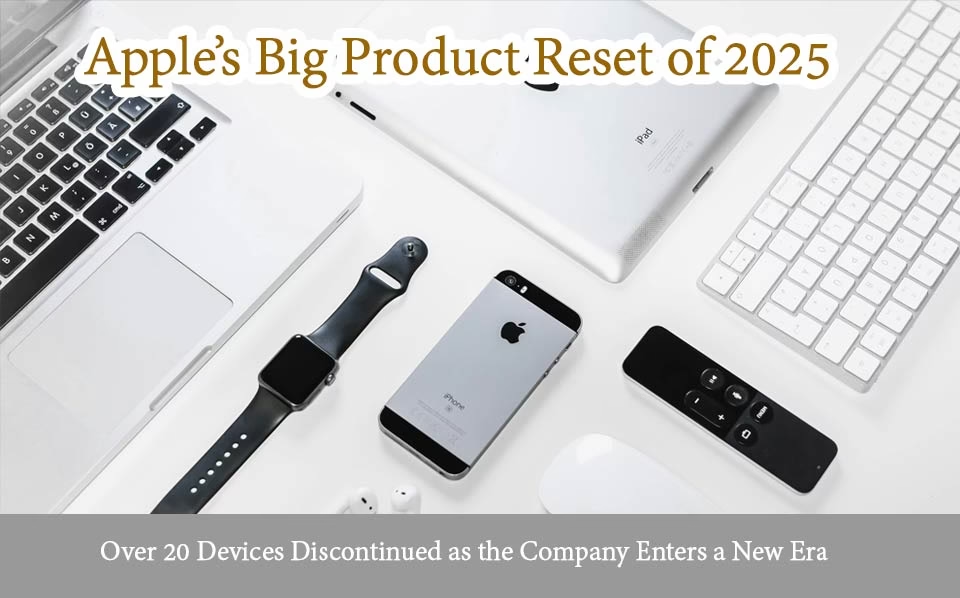
As 2025 moves toward its conclusion, Apple has carried out a sweeping reduction of its product lineup. Rather than announcing these changes through headline-grabbing events, the company has methodically removed more than 20 devices from sale across nearly every category it offers—smartphones, tablets, computers, wearables, and accessories.
This scale of discontinuation goes beyond routine product turnover. It reflects a broader recalibration of Apple’s hardware strategy, signaling a firm break from older design philosophies and transitional technologies in favor of a more uniform and forward-looking ecosystem.
Table of Contents
ToggleiPhone Evolution: Closing the Door on Apple’s Oldest Design Formula
One of the most consequential decisions of the year was Apple’s decision to retire the iPhone SE. With the launch of the iPhone 16e, Apple eliminated the final device that still relied on a design introduced nearly a decade ago.
For the first time since 2016, Apple’s iPhone lineup no longer includes any model featuring:
- A physical Home button
- Touch ID authentication
- LCD screen technology
- A compact display under six inches
- A Lightning connector
This shift represents more than the removal of a budget model—it marks the definitive end of Apple’s most familiar and long-running iPhone form factor.
In parallel, Apple also removed several other iPhone models from circulation. The iPhone 16 Pro and Pro Max gave way to the iPhone 17 Pro lineup, while the iPhone 15, 15 Plus, 14, and 14 Plus were also phased out. The disappearance of the “Plus” variants suggests Apple may be preparing a different approach to larger-screen phones, potentially replacing them with a thinner, more premium option widely rumored as an “Air” model.
iPad Lineup Simplified Through Internal Upgrades
Changes to Apple’s iPad offerings were less visible but no less intentional. Instead of introducing major design updates, Apple focused on improving performance, which resulted in the removal of several existing models.
Discontinued iPads included:
- iPad Pro models running the M4 chip
- iPad Air versions powered by the M2
- The 10th-generation standard iPad
Each was replaced by newer versions with updated processors. This approach reflects Apple’s effort to reduce overlap within the lineup while extending the relevance of each generation through silicon improvements rather than frequent redesigns.
Apple Watch: Refinement Over Reinvention
Apple’s wearable lineup also underwent routine turnover. With the introduction of the Apple Watch Series 11, Ultra 3, and SE 3, earlier versions—Series 10, Ultra 2, and SE 2—were quietly discontinued.
Notably, these updates focused on incremental refinement rather than dramatic hardware changes. The absence of a major processor leap suggests Apple is prioritizing reliability, software longevity, and consistency across its wearable ecosystem.
Macs: Accelerated Transition to Newer Silicon
Mac users saw some of the most significant changes of the year. Apple removed multiple computers still powered by earlier generations of Apple Silicon, including:
- Mac Studio models using M2 Max and M2 Ultra
- A 14-inch MacBook Pro variant with M4
- Both sizes of the M3 MacBook Air
- The 13-inch MacBook Air with M2
The decision to retire these machines underscores Apple’s intent to push its platform forward rapidly, even if that means ending support for relatively recent hardware.
Accessories Reflect a Broader Technological Shift
Apple’s accessory lineup also saw notable reductions. Among the discontinued or replaced items were:
- AirPods Pro 2, superseded by AirPods Pro 3
- The Vision Pro headset with an M2 chip, replaced by a newer revision
- The Lightning-to-3.5mm audio adapter
- The 30W USB-C power adapter in certain regions
- Older MagSafe accessories updated to support newer charging standards
The continued removal of Lightning-based products reinforces Apple’s full commitment to USB-C as its universal charging solution. Some of these changes vary by region, including markets such as the United States, United Kingdom, India, Japan, and Canada.
What This Transition Signals for Apple’s Future
Apple’s 2025 product reductions are less about shrinking its catalog and more about eliminating legacy constraints. The company is clearly aligning its hardware around a smaller set of standards, including:
- USB-C charging across devices
- Face ID as the primary authentication method
- OLED displays as the default screen technology
- A more streamlined, less redundant product lineup
For customers, this means fewer variations but clearer upgrade paths. For Apple, it creates a foundation for faster development, tighter integration, and long-term consistency.
Looking back, 2025 is likely to stand out as the year Apple decisively moved on from its transitional era—and fully committed to a unified hardware future.